Strategic Positioning: Competition Is Not About Beating Rivals

The Illusion of a Single Finish Line
We routinely reduce competition to a 100-meter dash. If a rival drops prices, we feel compelled to undercut them; if they roll out a new feature, we scramble to cram in even more. When our market share ticks upward, we claim victory; when it slides, we mourn defeat.
Yet this mindset rests on a fatal premise: that all competitors are sprinting along the exact same track toward a single finish line, and that only the first runner across the tape achieves success. In the real world of human decisions and business, this premise is fundamentally broken. Competition is not a school sports day with a single medal.
Core Conclusion: The purpose of competition is not to crush rivals and claim first place, but to create unique, irreplicable value and capture an equitable economic return. Competing to be "the best" inevitably forces rivals into mutual imitation, commoditizing products and triggering destructive price wars. Enduring competitive advantage stems not from outrunning others on their terms, but from deciding what NOT to do and forging an interlocking activity system that delivers unmatched value.
The moment we obsess over rivals and copy their moves, we lose sight of what customers actually need. Genuine competitive strength is not the destructive power to knock down competitors, but the disciplined ability to design a distinct game with rules of our own.
The Difference Between Being Better and Being Different
It is easy to mistake doing things a little faster, a little cheaper, or with slightly higher quality for "strategy." In reality, this is merely Operational Effectiveness. Performing similar activities better than rivals is a baseline requirement for survival, not a sustainable source of advantage.
The moment companies fixate on benchmarking competitors, the market stumbles into competitive convergence. As rivals copy each other’s best practices, meaningful distinctions evaporate. When offerings become interchangeable in the eyes of the customer, the only remaining battleground is self-destructive price slashing.
True strategy begins not with striving to be better than competitors, but with deliberately choosing to be different. It means securing a strategic position that avoids head-on collision from the start.
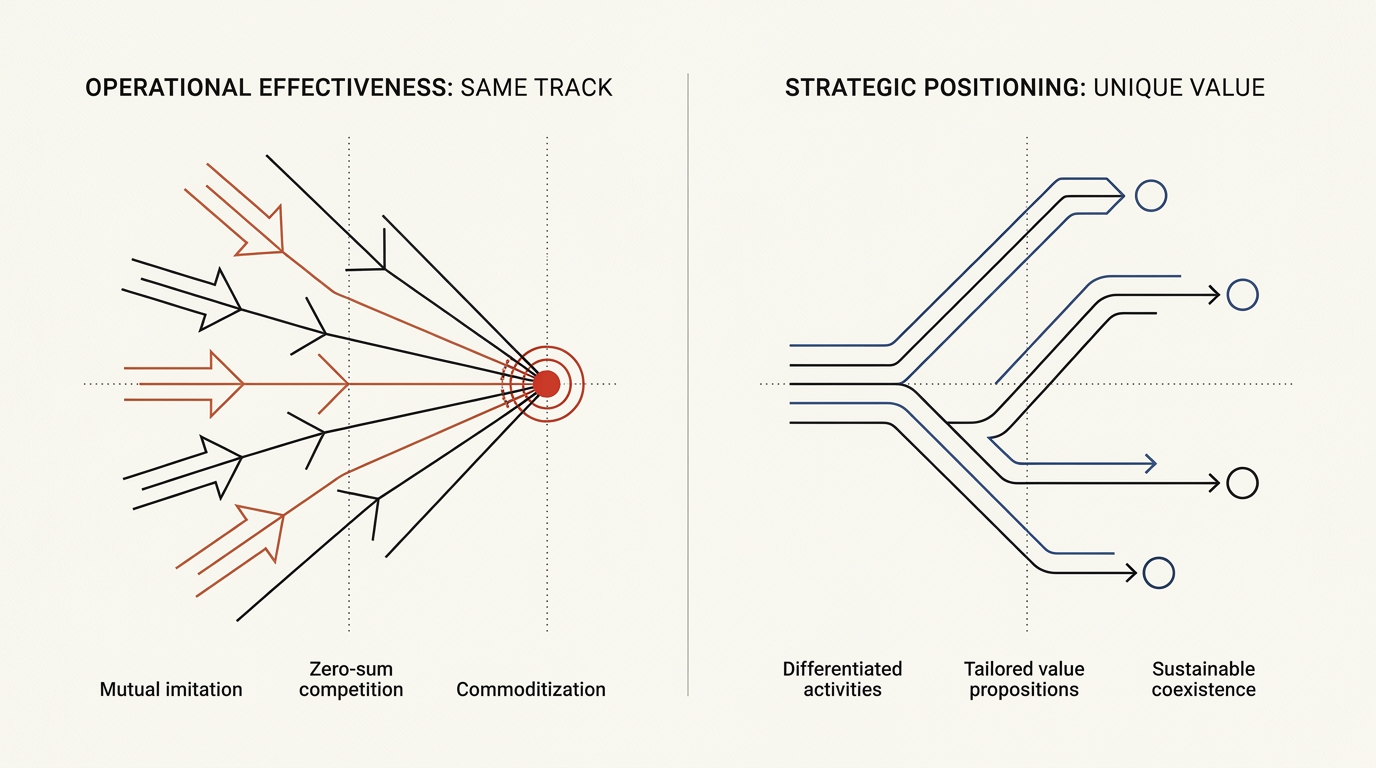
The Essence of Strategy Is Choosing What NOT to Do
IKEA’s historic ascent in the furniture market did not stem merely from selling affordable tables and chairs. Rather, it came from deliberately abandoning the traditional conveniences that conventional furniture showrooms took for granted. IKEA refused to deliver assembled goods to customers’ doors, refused to provide on-site assembly, and forced shoppers to drive out to massive suburban warehouse stores.
For customers who demand white-glove service and turnkey delivery, IKEA is an awful experience. But IKEA never tried to please everyone. Instead, for customers willing to trade their own labor for clean Scandinavian design at dramatically lower prices, IKEA designed an interlocking system: flat-pack packaging, logistics, catalogue design, and warehouse store layouts all reinforcing one another.
Traditional luxury showrooms could not replicate IKEA, not because they lacked engineering capability, but because copying IKEA’s flat-pack model would cannibalize their existing customer relationships and brand reputation. Strategy is ultimately a matter of trade-offs: knowing what to sacrifice in order to excel decisively.
Why Big Companies Still Fail
Many founders and executives treat gross revenue and market share as the definitive scorecards of strength. Yet competition is not just a battle to attract customers; it is a tug-of-war over who captures the economic value being generated.
A company can achieve number-one market share, but if suppliers hold monopolistic leverage, or customers possess massive bargaining power, or substitute options are abundant, virtually zero profit remains on the bottom line. This is why behemoths that bloated their top lines without economic defensibility routinely slip into bankruptcy.
What matters is not sheer volume, but enduring profitability. The goal of business is not to conquer the world and eradicate rivals, but to build an economic moat that sustainably secures a fair return on the value you create.
Why We Struggle to Be Different
Step outside the corporate balance sheet, and this principle casts an uncomfortable light on personal ambition. Why do we obsess over outrunning our peers rather than carving out our own distinct path?
From childhood, we were evaluated against standardized tests, uniform class rankings, and singular definitions of prestige. We absorbed the collective illusion that sprinting faster along the crowded highway is the safest choice. Yet when everyone competes to be the best on the exact same track, society sinks into exhaustion, burnout, and chronic imitation.
Racing to be "the best" leaves room for only one champion and countless disappointed runners. Striving to be unique allows countless individuals to flourish through distinct value. In career and in life, true mastery lies not in exhausting yourself on someone else’s stage, but in building an arena where nobody can compete with you on your own terms.
Two Actionable Decision Principles:
1. Refuse to be the best—choose to be unique: The moment you copy someone else’s playbook, your margin evaporates. Define the single value only you can deliver.
2. Decide what to abandon first: A plan that attempts to satisfy everyone is not a strategy; it is vanity. Great strategy is revealed by what you consciously sacrifice.
True competition is not about perfecting the art of knocking down rivals. It begins with the liberating realization that you never had to run their race in the first place.
Further Questions
All Essays
Why does linking bonuses to metrics erode craft and collaboration? Exploring Goodhart's Law, the Holmstrom-Milgrom multitask model, and Edward Lazear's Safelite evidence to map when performance pay succeeds versus when it destroys institutions.

Why do visionary executive directives morph into unintended behaviors? Exploring Graham Allison's three decision-making models: Rational Actor, Organizational Process (SOP), and Bureaucratic Politics.