Heuristic Decision Making: Why Thinking Less Can Be More Accurate

Does More Information Lead to Better Decisions?
When facing consequential decisions—changing careers, investing, signing a lease, or hiring a key teammate—our immediate impulse is to open more browser tabs. We bookmark dozens of analyses, scrutinize financial metrics and background references, and fill spreadsheets with every conceivable variable. The more information we accumulate, the calmer we feel. We assume that because we read more and weighed more factors than anyone else, our odds of failure must have dropped.
The bottom line is that this common assumption is wrong. The volume of information and the accuracy of a decision do not scale together. In a noisy, uncertain world, an individual who cuts down to one or two decisive criteria and acts swiftly often achieves a higher hit rate than someone running elaborate statistical models or deliberating for weeks.
Core Conclusion: In an uncertain world, attempting to calculate every variable inevitably leads to overfitting—mistaking past random fluctuations (noise) for enduring laws. Simple rules that ruthlessly discard secondary information and focus on just one or two decisive signals dramatically reduce predictive error. Thinking less is not intellectual laziness; it is a refined strategy for maximizing accuracy in a noisy world.
This does not mean one should act on reckless whim or baseless impulse. Rather, it means that the complex calculations we mistake for rationality malfunction in the presence of real-world noise. True rationality begins not with asking what else we can uncover, but with knowing what we can safely ignore.
Why We Obsess Over Calculation
We have been trained to distrust intuition. Deciding by gut feel is dismissed as reckless, while brandishing thick slide decks and complex spreadsheets commands immediate deference as prudent and analytical. If only to shield ourselves from blame when things go wrong, we amass more numbers.
Yet real-world dilemmas are not standardized test papers with neat answers waiting at the back of the book. In an incomplete, rapidly fluctuating environment, factoring in every variable is not merely impossible—it actively blurs our vision.
A truly effective decision rule is not one loaded with mathematical complexity, but one that fits the structure of the operating environment. The more complex the environment, the simpler the rule must be.
Overfitting: Mistaking Noise for Truth
This principle is evident even in a simple quiz. When asked to determine which of two foreign cities has a larger population, individuals who evaluate dozens of statistics—surface area, municipal budget, transit grids—frequently score equal to, or worse than, those who simply pick whichever city name sounds familiar. In an environment where major metropolitan centers are naturally mentioned more frequently in daily discourse, simple name recognition acts as a high-fidelity signal that cuts straight through dozens of competing metrics.
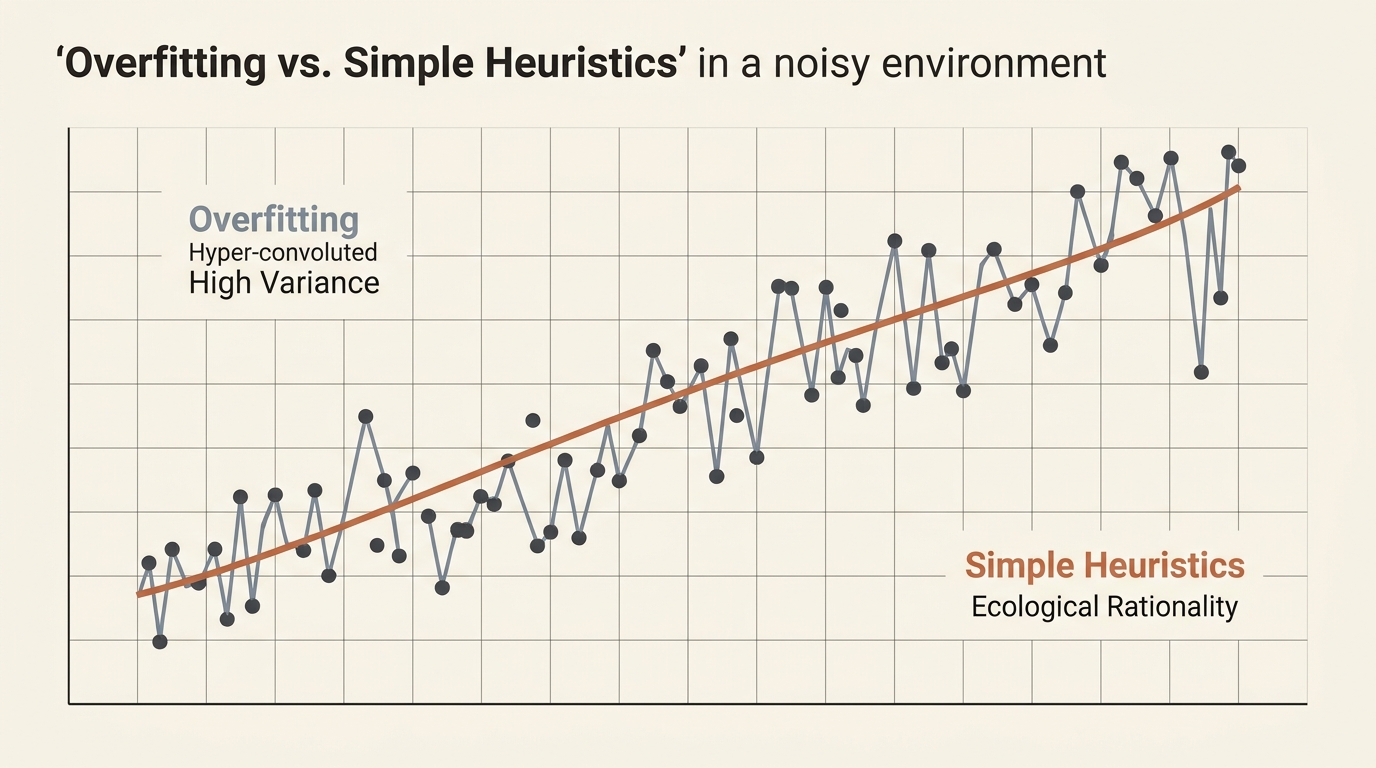
By contrast, complex predictive models fall into a fatal trap. Historical records are invariably contaminated with transient accidents and one-off flukes—meaningless noise that will never repeat in the same way. The more intricate the model, the more likely it is to mistake this noise for a fundamental pattern and memorize it. In statistics, this is known as overfitting.
The result is a model that scores 100% on past tests, but fails dramatically when confronted with tomorrow’s reality. A simple rule that discards secondary factors refuses to be swayed by random blips. By accepting minor imperfections on past data, it curbs future volatility and preserves genuine predictive power.
When Should You Stop Looking?
The single greatest culprit behind poor decisions is not a lack of data, but the inability to stop searching.
Reading one more report or checking one more reference provides temporary emotional comfort. Yet information gathering incurs real costs: time, attention, and compounding opportunity costs. More crucially, if the additional information is unlikely to overturn your current preference, gathering it is not thoroughness—it is merely delaying the anxiety of committing to a choice.
Sound decision-making requires an explicit Stopping Rule. When evaluating alternatives, examine the single most diagnostic criterion first. The moment a clear distinction emerges on that factor, stop searching immediately and decide.
This approach does not weigh every variable equally. It bets on decisive signals and cuts the rest away. While popular culture mistakes endless deliberation for prudence, true intellectual ability in a messy reality lies not in uncovering more facts, but in knowing what can be safely ignored to finalize a choice.

Where Simplicity Fails and Rules for Practice
Of course, simple decision rules are not a universal cure. There are domains where simplicity clearly breaks down.
First are domains with negligible noise and strict deterministic laws. In celestial mechanics, semiconductor fabrication, or structural engineering simulations—where physical laws hold constant and massive clean datasets exist—complex multivariate models that calculate thousands of parameters are decisively superior.
Second are adversarial environments where others intentionally manipulate signals. In markets rife with predatory marketing, astroturfed reviews, or fraudulent investment pitches designed specifically to exploit mental shortcuts, sticking blindly to simple rules leads to catastrophic losses. When surface cues are weaponized as bait, unreflective simplicity is merely negligence.
Two Actionable Decision Principles:
1. Gauge the noise of your environment: Where physical laws govern and data is pristine, rely on precision calculation; where human psychology and market volatility dominate, trust simple heuristics.
2. Define your Stopping Rule in advance: If you cannot answer what specific finding would overturn your pending decision, you already have enough information to act.
Ultimately, neither the advice to "always trust your gut" nor the demand to "endlessly collect data" offers complete guidance. What matters first is the discernment to see whether you stand in a world governed by noise or one ruled by controlled laws. Only then can you ask the right question: will this next piece of information actually change what I choose?
Further Questions
All Essays
Why does linking bonuses to metrics erode craft and collaboration? Exploring Goodhart's Law, the Holmstrom-Milgrom multitask model, and Edward Lazear's Safelite evidence to map when performance pay succeeds versus when it destroys institutions.
Why do visionary executive directives morph into unintended behaviors? Exploring Graham Allison's three decision-making models: Rational Actor, Organizational Process (SOP), and Bureaucratic Politics.