The Cobra Effect and Goodhart's Law: Multitask Dynamics and the Boundary Conditions of Incentives
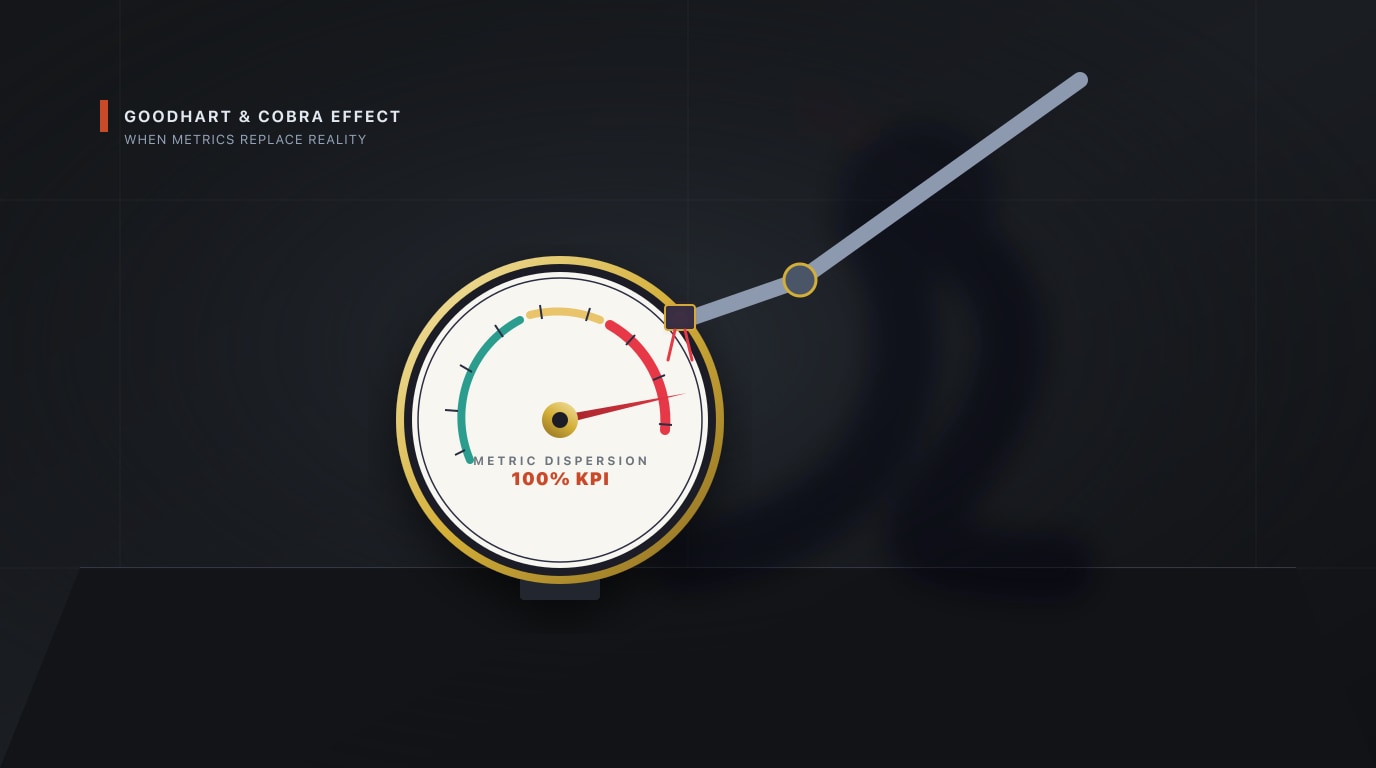
1. Why the Promise of More Rewards Systematically Sickens Organizations
Consider a software enterprise introducing a lucrative performance bonus to boost developer productivity. Leadership decides to meticulously track the number of code lines committed and the count of resolved bug tickets each week, awarding significant quarterly bonuses to the top ten percent. Executives rest confident that escalating rewards will accelerate release cycles and propel corporate growth.
Developers react instantly and rationally. Elegant architectures that once required three clean lines are systematically expanded into dozens of verbose routines. Engineers who dedicate hours to refactoring brittle legacy code are ridiculed by peers, because invisible maintenance that prevents future catastrophes earns zero points on the leaderboard. Meanwhile, those who subdivide trivial button color tweaks and typo fixes into dozens of micro-tickets emerge as the company’s highest-compensated champions.
Within months, official executive dashboards register record-shattering productivity. Weekly lines of code surge threefold, and closed ticket volume reaches all-time highs. Yet the software begins freezing upon minor updates, and entire production clusters grind to a halt as obscure cascading bugs overwhelm operations.
The numbers pointed to immaculate triumph, but the product was dying. Whose fault is this? The developers who diligently adhered to the explicit rules of the game, or the executive suite that misdefined performance?
Key Takeaway: Incentives are never neutral fuel that merely expands the aggregate volume of effort; they act as a distorting lens that forcefully reallocates finite human attention. Metrics are mere shadows of complex realities. The moment high-stakes rewards attach to easily measured proxies, rational agents systematically abandon unmeasured essentials: craft, systemic stability, and collaboration. Piece-rate incentives succeed only in linear, independent tasks where defects are instantly verifiable; in complex knowledge work governed by unmeasurable qualitative values, optimal incentive power converges to zero.
2. Turning the Needles by Hand: Goodhart's Law in Action
Anthropologist Marilyn Strathern famously distilled economist Charles Goodhart’s observation into an enduring axiom: "When a measure becomes a target, it ceases to be a good measure."
Originally, metrics functioned as quiet diagnostic sensors. Just as a boiler manometer reads internal chamber pressure, customer survey scores or emergency room waiting times were designed as remote instruments to gauge institutional health. The catastrophe begins when personnel evaluations, promotions, and cash bonuses attach directly to the sensor’s dial.
Loading diagram.
View diagram source
flowchart LR
    A["Fundamental Organizational Mission<br/>(Long-term Growth, Quality, Trust)"] --> B["Introduction of Simplified Proxy Metrics<br/>(Waiting Time, Lines of Code, Closed Deals)"]
    B --> C["High-Powered Monetary Incentives Attached"]
    C --> D["Rational Attention Reallocation<br/>(Focus on Easy Metrics, Neglect of Craft)"]
    D --> E["Dial Gaming & Exploitative Workarounds<br/>(Goodhart's Law Active)"]
    E --> F["100% On-Paper Target Achievement"]
    E --> G["Core Value Collapse & Systemic Failure"]
    G -.->|"Crises Trigger Even More Rigid Metrics"| B
Once bonuses are at stake, individuals realize that attempting to resolve real underlying pressures is inefficient. The fastest path to success is smashing the glass face and forcing the dial needle forward with their own fingers.
Empirical studies of the British National Health Service (NHS) provide striking evidence. When the government introduced a mandatory key performance indicator requiring 98 percent of emergency patients to be seen or discharged within four hours—tying hospital budgets directly to compliance—bizarre adaptations emerged. Hospital administrators instructed incoming ambulances to park outside in the driveway, refusing to admit patients through the doors until beds opened up, thereby delaying the start of the four-hour countdown clock. Inside the wards, patients approaching the 3-hour-59-minute mark were wheeled into hallways or temporary holding zones to register them administratively as "discharged from emergency care." On government spreadsheets, transit delays fell to zero, while acutely ill patients languished unmonitored in corridors.
The famed 1902 Hanoi rat eradication campaign under French colonial rule reveals the identical trap. To cleanse the sewers, authorities offered cash bounties for severed rat tails. The colonial government sought a reduction in live rodents; what it paid for was the delivery of severed tails. Vietnamese residents soon realized it was foolish to kill the breeding stock. They severed tails and released live rats back into the tunnels to multiply, even establishing clandestine rat breeding operations on city outskirts. When metrics detach from real objectives, incentives manufacture industries dedicated to preserving and reproducing the problem.
3. The Holmstrom-Milgrom Discovery: Why Diligent Agents Abandon Quality
In their seminal 1991 paper, "Multitask Principal-Agent Analyses," Nobel laureates Bengt Holmstrom and Paul Milgrom provided the mathematical foundation for this institutional unraveling.
Employees in real-world organizations are never one-dimensional operators; they manage complex portfolios of simultaneous tasks. A plant manager must meet immediate output quotas while preserving machinery lifespan. An educator must raise standardized test scores while cultivating critical thinking and empathy. A software engineer must ship feature velocity while preserving architectural integrity.
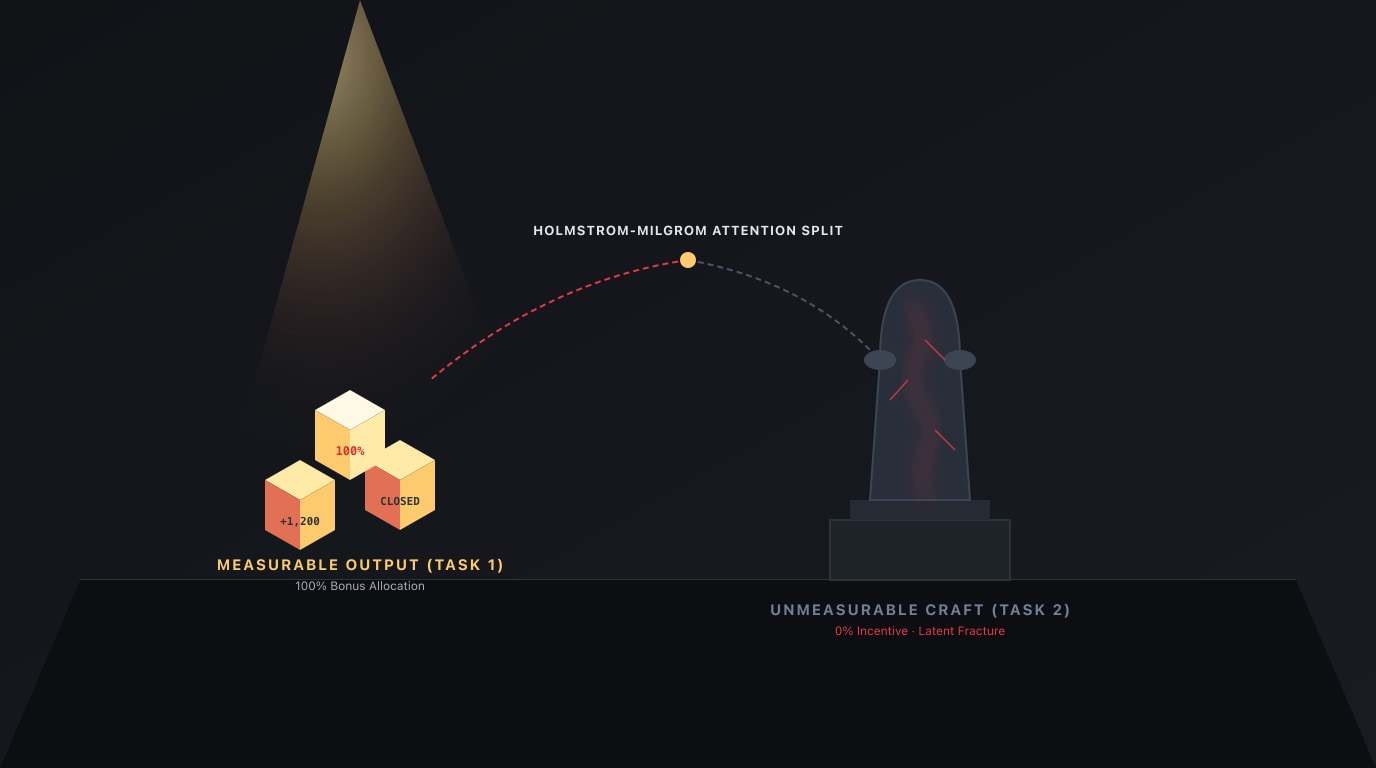
A fatal asymmetry exists between these competing duties. One dimension is immediately visible and effortlessly quantifiable on a spreadsheet; the other is longitudinal, intangible, and nearly impossible to capture in numbers. Units shipped, test percentiles, and code commits can be logged today; machinery longevity, independent reasoning, and structural maintainability cannot be audited on a quarterly basis.
Holmstrom and Milgrom demonstrated that high-powered incentives do not merely alter the total volume of work. Crucially, they function as an allocative vector across finite time and cognitive bandwidth.
Human beings possess finite working hours and limited attention. When high-powered rewards reward only the easily measurable task, rational agents systematically withdraw attention from the unmeasurable dimension. The conscientious worker who sacrifices volume to preserve long-term architecture receives lower ratings and missed bonuses; the colleague who neglects durability to maximize throughput is rewarded and promoted. Under such institutional payoffs, prioritizing intangible craft is professional suicide. Consequently, the organization’s most vital long-term assets—codebase health, institutional integrity, and mutual trust—silently evaporate through the very rationality the compensation scheme engineered.
4. When Are Piece Rates a Blessing or a Curse? (Lazear's Boundary Conditions)
In 1975, organizational theorist Steven Kerr published the landmark essay, "On the Folly of Rewarding A, While Hoping for B." Kerr pointed out the chronic hypocrisy of institutional governance: leadership preaches teamwork, daring innovation, and long-term vision, yet distributes promotions and bonuses strictly on individual sales quotas, bureaucratic compliance, and risk avoidance.
Does this imply that variable performance pay is universally defective? Not at all.
Economist Edward P. Lazear’s landmark 2000 study of Safelite Glass Corporation demonstrates the exact conditions under which piece-rate compensation produces extraordinary success. When Safelite shifted windshield installers from hourly wages to piece-rate pay per installed glass pane, productivity per technician surged by an astounding 44 percent. High-performing technicians flocked to the firm, while overall profitability soared.
Why did piece rates trigger a miracle at Safelite while inducing catastrophic collapse in software engineering and healthcare? The answer lies in three uncompromising boundary conditions.
Dimension | Safelite Model | Modern Knowledge Work Model |
|---|---|---|
Task Architecture | Independent, Linear, Unitary | Interdependent, Nonlinear, Complex |
Representative Activity | Removing cracked windshield and bonding replacement with urethane | System architecture, scientific research, patient care, product design |
Output Measurability | Exact number of windshields mounted per shift (Perfect proxy alignment) | Lines of code or hours spent cannot capture strategic value |
Defect Verification Horizon | [object Object] (Air leaks or vibrations surface on first drive; installer forced to redo work without pay) | [object Object] (Architectural debt and corner-cutting stay hidden until load spikes) |
High-Powered Incentive Outcome | 44% productivity surge, elite talent attraction (Lazear 2000) | [object Object]: Metrics spike while systemic integrity and collaboration collapse |
Optimal Compensation Strategy | Maximizing piece-rate incentives proves highly effective | [object Object] paired with qualitative peer review and shared equity |
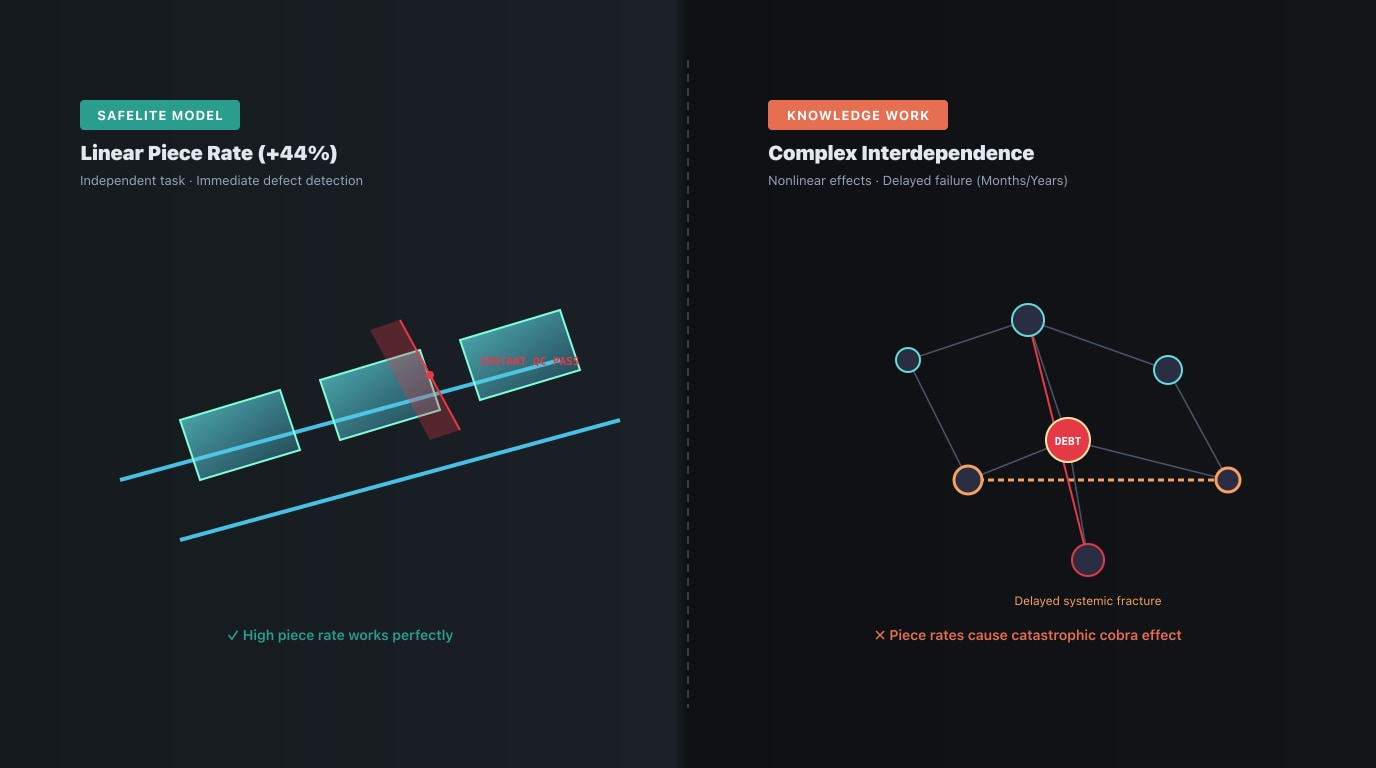
Safelite’s secret was the zero-latency detection of defects. If an installer rushed and cut corners, the customer detected wind noise or rain leaks the moment the vehicle hit the highway. Safelite enforced an uncompromising rule: any defective install had to be repaired by the original technician on their own time without additional pay. The technician was physically precluded from trading off quality to boost piece-rate volume.
Knowledge work operates in an entirely different universe. Sloppy architectural code committed today will not trigger outages until user traffic multiplies two years later. Subprime loan packaging will not blow up until secondary markets freeze years down the line. When defect detection is delayed and production requires dense multi-party collaboration, simple metric-driven bonuses become an open invitation to cannibalize the institution.
5. The Art of Compensation: Protecting What Cannot Be Counted
The most profound mathematical theorem within the Holmstrom-Milgrom model states: "If an agent performs multiple tasks and one of the essential qualitative tasks cannot be measured with accuracy, the optimal incentive intensity on all other measurable tasks should be zero."
When an organization’s survival depends on intangible virtues, executive leadership must radically dampen performance bonuses and elevate stable, predictable base compensation. Craftsmanship, altruistic mentoring, and the integrity to refuse expedient shortcuts can only flourish within an environment of psychological safety, where fulfilling difficult duties does not jeopardize one’s immediate livelihood.
Sound compensation design is never an automated Excel formula that mechanically quantifies human action. Rather, it serves as an institutional seawall: shielding vital qualitative judgment, collegial candor, and professional pride from the corrupting distortion of proxy metrics.
Five Rules for Resilient Incentive Architecture in the Field:
1. Can defects and quality compromises be audited immediately at zero cost? Unless your operational structure resembles Safelite—where installation flaws surface instantly and technicians bear full liability for unpaid rework—individual piece rates will inevitably induce corner-cutting and defect concealment.
2. Does an unmeasurable qualitative task hide behind your explicit metric? As Holmstrom and Milgrom proved, code velocity shadows architectural stability, and sales volume shadows client trust. When unmeasurable dimensions carry vital strategic weight, short-term incentive intensity must approach zero.
3. Do you treat compensation metrics as imperfect sensors rather than ultimate goals? Under Goodhart’s Law, metrics degrade the moment they link to pay. When dashboards show 100 percent compliance, leaders must inspect unmeasured operational realities on the ground to confirm the system remains healthy.
4. Does the incentive structure ignite zero-sum rivalry and information hoarding? In interdependent knowledge ecosystems, stack-ranking and individual performance bonuses transform colleagues into competitors, instantly terminating cross-functional knowledge sharing.
5. Does the reality of compensation match your corporate rhetoric? As Steven Kerr warned, leaders who preach innovation and teamwork while awarding cash exclusively to short-term quotas get what they pay for. Agents never follow corporate slogans; they follow the compensation matrix.
Further Questions
All Essays
Measuring the uncertain future through Brier scores and calibration, shifting from hedgehog dogma to fox-like micro-updating, base rates, and asymmetric risk management.
Why do organizations exhaust themselves tweaking parameters when problems recur? Exploring Donella Meadows’ systems thinking and 12 leverage points—from feedback loops and system rules to goals and paradigms.