Twelve Leverage Points in a System: From Parameter Tweaking to Transcending Paradigms

When complex organizations or economic systems falter, the remedies policy makers reach for first are predictably mundane: raising or lowering budgets, introducing new subsidies, and tweaking tax rates or interest benchmarks. Enormous political energy and countless meetings are consumed in this pursuit of numerical tinkering. Yet even after massive resources are deployed and regulations fine-tuned, systems inexorably settle back into chronic stagnation and unintended side effects.
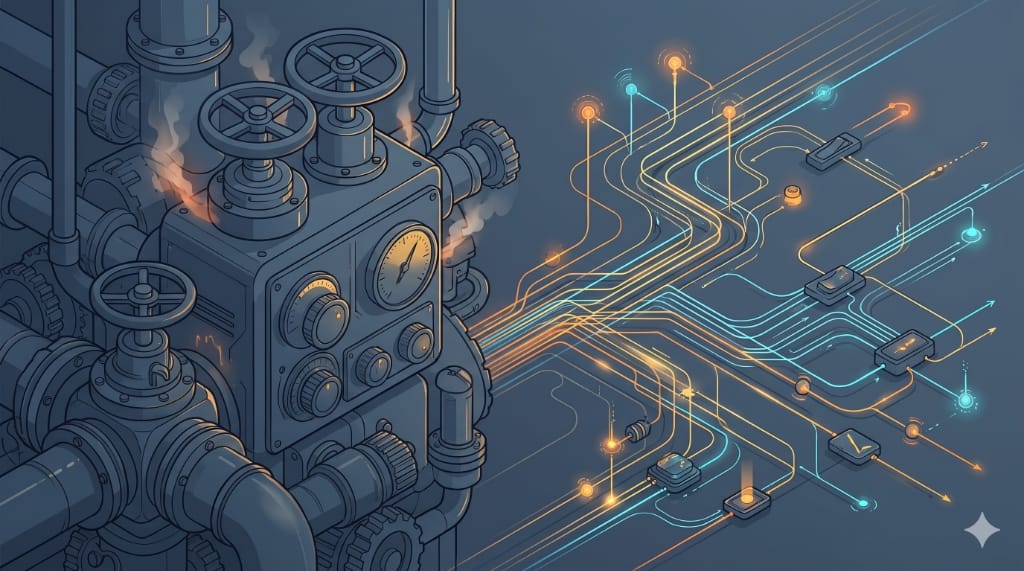
Most policy debates concentrate 99 percent of their energy on lower-order parameters like subsidies and taxes, but so long as feedback loops, rules, and overarching goals remain unchanged, system behavior will not alter. Genuine systemic transformation occurs not by rebuilding costly physical conduits, but by reconnecting severed information flows (6th), rewriting operational rules (5th), and shifting overall system goals (3rd) and paradigms (2nd and 1st).
Donella Meadows, a student of system dynamics pioneer Jay Forrester, explained this persistent policy failure through the concepts of counterintuitiveness and policy resistance. People intuitively grasp where problems cluster within a system, but because they overlook underlying feedback loops and delayed responses, they frequently push leverage points in precisely the wrong direction, exacerbating the very crises they intend to resolve.
The Bathtub Metaphor and Lower Leverage Limits
Meadows analogized the anatomy of any system to a simple bathtub. The accumulated volume of water represents a stock, while inflow from the faucet and outflow through the drain represent flows. One can turn the tap to alter momentary inflow, but bathtub water level shifts only gradually through temporal accumulation. Around this core dynamic operate negative feedback loops that perceive gaps between desired and actual water levels, governed by inevitable information delays.
Among Meadows' twelve leverage points, positions 12 through 9 occupy everyday political discourse. Twelfth-ranked parameters, such as tax rates and subsidy levels, matter acutely to individuals directly situated on flow lines, yet changing numbers leaves overall structure unaltered. Eleventh-ranked buffer stocks absorb shocks, but oversized buffers induce sluggish responsiveness and heavy maintenance costs. Tenth-ranked physical transport and distribution networks require vast capital and lengthy construction times, trapping systems in path dependence. Ninth-ranked delays, when misaligned with system velocity, spark systemic overshoot and destructive oscillations.
Leaping into Information, Rules, and Self-Organization
When intervention shifts from physical hardware to information and structural governance, leverage multiplies exponentially. Eighth-ranked negative feedback loops preserve homeostasis, yet short-sighted organizations frequently dismantle them for immediate cost savings, forfeiting resilience. Seventh-ranked positive feedback loops generate self-reinforcing exponential growth or catastrophic decline; dampening their baseline gain is far more effective than improvising reactive remedies after runaway cascades begin.
Sixth-ranked information flow structure represents an extraordinary inflection point in cost-effectiveness. Altering who has access to what data transforms macro behavior without moving a single brick. Meadows cited electric utility meters: relocating them from dark basements to front entrance halls immediately dropped household power consumption by 30 percent. Similarly, requiring industrial polluters to publicly disclose toxic emissions slashed chemical releases nationwide without new prohibitive mandates. Reconnecting severed feedback channels is systemic elegance.
Fifth-ranked rules define system boundaries, incentives, and punishment schedules. Crucially, true leverage resides in who wields power to write and interpret these rules. Fourth-ranked self-organization empowers systems to evolve new structures and behavioral repertoires in changing environments. Protecting genetic variability, open-source experimentation, and institutional diversity ensures long-term adaptive vitality.
Comparative Framework of Twelve Leverage Points
Rank | Leverage Point | Operational Mechanism | Diagnostic Question |
|---|---|---|---|
12 | Parameters and Numbers | Modulating flow volume (taxes, subsidies) | Does changing numerical values leave existing structures intact? |
11 | Buffer Stock Sizes | Absorbing volatility and stabilizing stock | Does the buffer absorb shocks or generate costly sluggishness? |
10 | Material Stock and Flow Structure | Physical layout and transport geometry | Is altering physical infrastructure too costly and slow? |
9 | Delays Relative to System Change | Lags between perception, decision, and effect | Do lengthy delays cause systemic overshoot and severe oscillation? |
8 | Negative Feedback Loop Strength | Preserving homeostasis and correcting shocks | Have critical emergency safety loops been gutted for efficiency? |
7 | Positive Feedback Loop Gain | Dampening runaway self-reinforcing spirals | Can exponential winner-take-all loops be tamed at their source? |
6 | Information Flow Structure | Restoring missing feedback and transparency | Have decision makers been linked directly to hidden consequences? |
5 | System Rules and Governance | Incentives, constraints, and authority | Who holds constitutional authority to alter operational rules? |
4 | Power of Self-Organization | Evolving novel structures and adaptations | Has obsession with uniformity destroyed the seeds of experimentation? |
3 | System Goals | Overarching optimization target for all loops | What real outcome does daily operational behavior actually maximize? |
2 | Mindset or Paradigm | Foundational assumptions generating rules | Can prevailing worldview failures be exposed to test alternatives? |
1 | Transcending Paradigms | Remaining unattached to any single dogma | Do we maintain humble awareness that no model captures total reality? |
Loading diagram.
View diagram source
flowchart TD
    subgraph Mindset ["Upper Tier: Paradigm and Purpose"]
        L1["1st. Transcending Paradigms"]
        L2["2nd. Mindset and Paradigm"]
        L3["3rd. System Goals"]
    end
    subgraph Governance ["Middle Tier: Information and Rules"]
        L4["4th. Self-Organization"]
        L5["5th. System Rules"]
        L6["6th. Information Flows"]
    end
    subgraph Dynamics ["Feedback Loop Tier: Dynamic Balance"]
        L7["7th. Positive Feedback Gain"]
        L8["8th. Negative Feedback Strength"]
        L9["9th. Delay Management"]
    end
    subgraph Physical ["Lower Tier: Physical Plumbing and Numbers"]
        L10["10th. Material Stocks and Flows"]
        L11["11th. Buffer Sizes"]
        L12["12th. Parameters and Numbers"]
    end
    L1 -->|"Governs"| L2
    L2 -->|"Derives"| L3
    L3 -->|"Aligns"| L4
    L4 -->|"Creates"| L5
    L5 -->|"Controls"| L6
    L6 -->|"Wires"| L7
    L7 -->|"Accelerates"| L8
    L8 -->|"Corrects"| L9
    L9 -->|"Paces"| L10
    L10 -->|"Accumulates"| L11
    L11 -->|"Calibrates"| L12
System Goals, Paradigms, and Intellectual Humility
The apex tiers, positions 3 through 1, constitute the guiding consciousness of any system. Third-ranked goals reflect not superficial slogans, but the objective functions toward which actual human behaviors converge. When an entire economy organizes solely around gross domestic product growth rather than societal wellbeing, it ravages natural capital and community fabrics to inflate arithmetic output. Shifting this goal realigns every subordinate rule, channel, and feedback loop.
Second-ranked paradigms embody the shared social assumptions out of which goals and rules arise. As Thomas Kuhn demonstrated in scientific revolutions, paradigm shifts suddenly render existing edifices obsolete while birthing new institutional realities. Yet Meadows reserved the highest leverage point, rank 1, for the power to transcend paradigms. Recognizing that no single worldview captures reality in its entirety, and cultivating the intellectual humility to discard mental models when circumstances demand, represents the pinnacle of systems mastery.
Further Questions
All Essays
An analysis of how exit, voice, and loyalty interact during institutional decline, explaining why easy alternatives often deplete internal reform capacity.

Explore all 25 tendencies in Charlie Munger’s psychology of human misjudgment, the Lollapalooza effect, and practical ways to improve decision procedures.