Procedural Humility and the Science of Checklists: Why True Experts Ask About What They Already Know
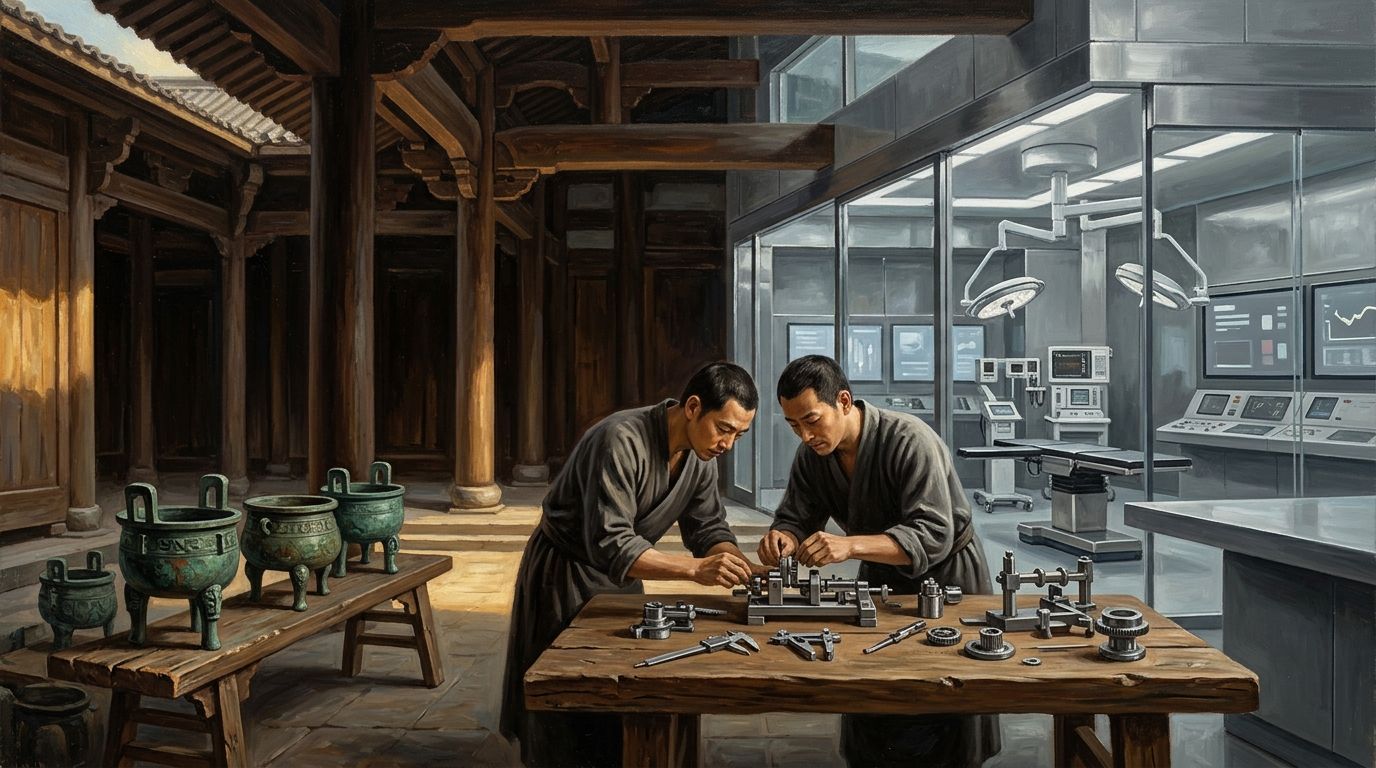
When someone enters a high-stakes workplace and begins asking front-line staff to verify the most elementary steps one by one, bystanders often mistake that caution for incompetence. We tend to assume that a true master acts effortlessly without needing to ask. Twenty-five hundred years ago, when Confucius entered the Grand Temple of Lu (dedicated to the founding Duke of Zhou), he faced the exact same ridicule. Renowned across the state for his mastery of ritual, Confucius nevertheless asked the temple attendants about every vessel and every procedural step. Hereditary aristocrats sneered: "Who said the son of that man from Zou knows ritual? On entering the Grand Temple, he asks about everything."
Upon hearing the mockery, Confucius did not offer an excuse; instead, he overturned their definition of expertise with three words: "That is ritual (是禮也)." Mastery does not consist in displaying stored knowledge through unilateral action. Rather, lowering one's ego before the reality of the field and cross-checking every step in real time is the very essence of ritual integrity.
In complex, knowledge-rich societies, most catastrophic failures stem not from ignorance (not knowing what to do), but from ineptitude (failing to apply known steps reliably under cognitive load and status arrogance). Confucius's practice of asking about everything in the Grand Temple (入太廟每事問) is both a cognitive safeguard against hubris and an institutional audit of boundary violations, and it works only when front-line practitioners hold the authority to question and halt senior decision-makers.
The Ridicule of the Outsider and Questions in the Grand Temple
The label "the son of the man from Zou" (鄹人之子) carried sharp class contempt. Confucius's father had been a provincial military officer from Zou rather than a member of the hereditary nobility in the capital. Having risen from humble administrative posts managing granaries and livestock through relentless self-study, Confucius was viewed as an upstart by the entrenched officials who monopolized temple ceremonies. To those insiders, authority meant performing ceremonies from memory without ever consulting subordinates.
Classical records in the Kongzi Jiayu and Shuoyuan, however, describe the Grand Temple not as a stage for displaying erudition, but as an architecture of extreme caution. At the temple steps stood a bronze figure whose mouth was sealed in three places, inscribed with a warning to guard one's speech and conduct. Beside it sat the tilting vessel (宥坐之器), which stood upright when empty, stayed level when moderately filled, and overturned the moment it was filled to the brim.
Actual placement of vessels and local sequences always differ subtly from textbook doctrine. Even the most learned scholar risks a procedural failure if he relies solely on memory without cross-checking with the officiating attendants on the ground. Where hereditary elites saw questioning as a confession of ignorance, Confucius saw unverified action as the highest risk.
Zhu Xi on Reverent Caution versus Jeong Yak-yong on Institutional Boundaries
Why did Confucius ask about rituals he had already studied for decades? East Asian commentary traditions produced two distinct explanations, and placing them side by side reveals both the cognitive and institutional functions of procedural questioning.

The first reading, formulated by Han commentator Kong Anguo and synthesized by Zhu Xi in his Collected Commentaries on the Analects (Lunyu Jizhu), centers on "asking even though one knows" (雖知亦問). Zhu Xi argued that Confucius was already famed for his knowledge of ritual, and precisely because human memory is fallible and familiarity breeds complacency, verifying known facts on site represents the pinnacle of reverent caution (敬謹之至). Here, the act of asking serves as an internal cognitive brake against overconfidence.
centuries later, the Korean scholar Jeong Yak-yong (Dasan) challenged this purely moral reading in his Lunyu Gogeumju. "If a sage spent his entire life studying ritual and yet had to ask about every single item out of sheer caution, what use would his learning be?" Dasan asked. Instead, he pointed to an institutional distortion inside the Grand Temple of Lu: over generations, the feudal state of Lu had improperly expanded its privilege and mixed the imperial rites of the Son of Heaven into a temple that ought to follow the boundaries of a feudal lord.
In Dasan's analysis, what Confucius knew was the legitimate ritual of a feudal state, whereas what the temple officers had laid out on the floor included unauthorized imperial usurpations. Had Confucius walked in and performed the ceremony without asking a single question, his silence would have ratified those transgressions as normal standard operating procedure (孔子不問而行之,是以爲當然也). By asking the attendants to state the basis for each vessel and step before acting, Confucius exposed the gap between legitimate rule and local drift. Where Zhu Xi identified a safeguard against personal cognitive error, Dasan uncovered a mechanism of institutional auditing against the normalization of deviance.
Analytical Dimension | Epistemic Caution (Kong Anguo & Zhu Xi: 雖知亦問) | Institutional Boundary Audit (Jeong Yak-yong: 論語古今註) | Modern High-Reliability Execution Science (Checklist Engineering) |
|---|---|---|---|
Primary Vulnerability | Overconfidence in personal memory and habitual omission by experts | Silent complicity in unauthorized local drift and boundary violations | Total system complexity exceeding human real-time working memory |
Purpose of Questioning | Re-verifying known procedures with front-line staff to prevent complacency | Publicly surfacing discrepancies between legitimate rules and local practice | Externalizing routine verification to free cognitive headroom for crises |
Risk of Silent Execution | Procedural slips caused by expert hubris | Ratifying the normalization of deviance as accepted standard | Preventable catastrophes driven by ineptitude rather than ignorance |
Source of Authority | Trust earned through humility rather than pretentious fluency | Clear normative boundaries established through public inquiry | Psychological safety and horizontal stopping power across ranks |
Failures of Ignorance versus Failures of Ineptitude
The dynamics Confucius demonstrated in the Grand Temple have been quantified in twenty-first-century intensive care units and flight decks. Modern philosophy of science and clinical safety distinguish between two root causes of human failure: ignorance, which occurs when scientific knowledge does not yet exist, and ineptitude, which occurs when the necessary knowledge is fully established yet practitioners fail to apply it consistently amid complexity and time pressure.
A landmark 2006 study published in the New England Journal of Medicine across 103 intensive care units (tracking 375,757 catheter-days) demonstrated how ineptitude operates. Preventing lethal bloodstream infections during central venous catheter insertion requires only five elementary steps: washing hands, cleaning the patient's skin with chlorhexidine, using full-barrier sterile drapes, wearing sterile attire, and removing unnecessary catheters promptly.
Not a single item on that list represents advanced medical discovery; every medical student knows all five. Yet under emergency pressure, fatigue, and the quiet arrogance of veteran physicians who felt insulted by routine reminders, at least one step was skipped in roughly a third of insertions. Just as the aristocrats of Lu mocked Confucius for asking about basics, senior clinicians initially viewed step-by-step verification as beneath their stature.
The research team introduced a five-item checklist paired with one decisive institutional rule: if a physician skipped any step on the list, the bedside nurse was explicitly authorized to question the omission and halt the procedure immediately. Within three months, the median rate of catheter-related bloodstream infections fell from 2.7 per 1,000 catheter-days to zero, achieving a 66 percent overall reduction across eighteen months.
Loading diagram.
View diagram source
flowchart TD
    A["Entry into High-Risk, High-Complexity Environment<br/>(Grand Temple Rites / ICU Procedure / Production Deployment)"] --> B{"Expert's Mode of Action"}
    B -->|"Unilateral Fluency (Acting Without Asking)"| C["Reliance on Long-Term Memory and Tacit Habit"]
    B -->|"Procedural Questioning (Asking at Every Step)"| D["Externalized Verification and Cross-Check with Staff"]
    C --> E["Working-Memory Overload and Silent Drift"]
    E --> F["Catastrophic Omission Driven by Ineptitude"]
    D --> G{"Presence of Horizontal Stopping Authority"}
    G -->|"Absent (Bureaucratic Box-Ticking)"| H["Cynicism and Empty Ritual (Zero Safety Gain)"]
    G -->|"Empowered (Mutual Inquiry and Halt Authority)"| I["Elimination of Basic Slips and Cognitive Headroom for Complex Judgment"]
Why does structured questioning work so powerfully? It is not because checklists turn experts into automatons. Human working memory is strictly bounded. By offloading predictable, mandatory checks onto a shared verification protocol, experts free up scarce cognitive headroom to handle genuinely unpredictable anomalies. Procedural humility does not replace expertise; it protects expertise from being consumed by routine memory load.
When Checklists Fail and the Authority to Question
Does handing out a printed checklist automatically prevent disasters? Empirical counter-evidence shows that the form alone accomplishes nothing.
Following the 2009 World Health Organization trial showing that surgical safety checklists cut mortality nearly in half across eight cities, governments worldwide mandated checklists by decree. Yet when researchers analyzed over 215,000 surgical procedures across 101 hospitals in Ontario, Canada after a province-wide mandate (Urbach et al., 2014), they found no statistically significant reduction in operative mortality (0.71 percent before versus 0.65 percent after) or surgical complications, despite hospitals reporting 98 percent compliance.

Why did infection rates drop to zero in the ICU intervention while 101 hospitals in Ontario saw virtually no improvement? The difference lay not in the paper form, but in whether a question could actually stop authority in its tracks.
When checklists are imposed as top-down administrative compliance without empowering junior staff to speak up or pause the workflow, teams resort to performative box-ticking. Surgeons proceed unilaterally while staff check the boxes after the fact to satisfy auditors. That is the exact bureaucratic hollowness Jeong Yak-yong critiqued: going through the motions while leaving underlying deviations untouched.
For Confucius's "asking about everything" to become living ritual (是禮也), two conditions must hold together. First, the most senior expert in the room must model epistemic humility by inviting verification rather than treating questions as challenges to status. Second, the institution must guarantee that any practitioner who spots a gap between rule and reality can ask "Why was this step skipped?" and halt the line without fear of retaliation.
Whether in clinical medicine, aviation, software deployment pipelines, or organizational governance, adding more checkboxes after an accident only breeds bureaucratic theater. True professionalism is never proven by how smoothly one acts without asking. It is proven at the exact moment an expert pauses before a procedure performed a thousand times before and asks a colleague on the ground to verify it once more.
Further Questions
All Essays
Why product feature races fail: redefining customer purchasing as hiring a solution for life progress, the three dimensions of jobs, and the four forces of progress.

Explore all 25 tendencies in Charlie Munger’s psychology of human misjudgment, the Lollapalooza effect, and practical ways to improve decision procedures.