Fleeting Trends and Enduring Knowledge: The Lindy Effect and the Novelty Bias

1. The Paradox of Generational Memes and the Insecure Veteran
An expert who has spent decades quietly mastering a craft is suddenly mocked on social media as out of touch simply for missing the latest youth slang. Conversely, the ephemeral sensibilities of teenagers and young adults on short-form video platforms are revered as the most urgent cultural imperatives of our time.
It has become common to watch experienced adults anxiously mimic youthful mannerisms, fearful that a book published just last year is already obsolete. We yawn in front of classical texts that have survived centuries, yet our pulse quickens at an anonymous online trend surfaced this morning.
Age alone does not confer wisdom, but does youth in itself represent superior insight? Why does time-tested knowledge consistently yield to the weightless charm of the novel?
Underlying Mechanism: We obsess over fleeting memes and cravenly seek the validation of youth culture not from an intellectual deficit, but because we mistake the field of cultural consumption for the field of production. Our evolutionary novelty bias joins forces with zero-marginal-cost information noise, leading us to surrender our authority to superficial visibility. True intellectual autonomy requires stepping off the treadmill of trends and practicing Via Negativa, filtering out high-frequency noise using the Lindy Effect as our compass.
2. The Inversion of Symbolic Capital: Fields of Consumption versus Thought
In a 1978 dialogue, French sociologist Pierre Bourdieu observed that youth is just a word. Biological age is merely a chronological fact, but society actively fabricates the boundary between the young and the old to allocate power, resources, and social legitimacy.
In traditional societies, elders held symbolic authority because they monopolized scarce historical knowledge and institutional memory. The digital platform economy inverted this structure. Technology platforms packaged the rapid, reactive consumption patterns of young demographics into the premier cultural capital of modern commerce.
Field of Evaluation | Dominant Capital Form | Primary Criteria | Temporal Durability |
|---|---|---|---|
Field of Production & Expertise | Economic capital, technical depth | Problem-solving, risk underwriting | Decades of compounding compound interest |
Field of Media & Consumption | Symbolic trend capital, visibility | Novelty, immediate buzz, virality | Rapid depreciation over weeks or months |
Field of Intellectual Inquiry (Lindy) | Cognitive capital, structural models | Systemic truth, multi-generational survival | Centuries of universal relevance |
The crisis emerges when veterans of production enter the field of media consumption and unthinkingly adopt its rules. Generational labels and ephemeral slang are nothing more than transient theater. When we import these shallow metrics into our life principles and study habits, we succumb to artificial status anxiety and debase our hard-won insight.
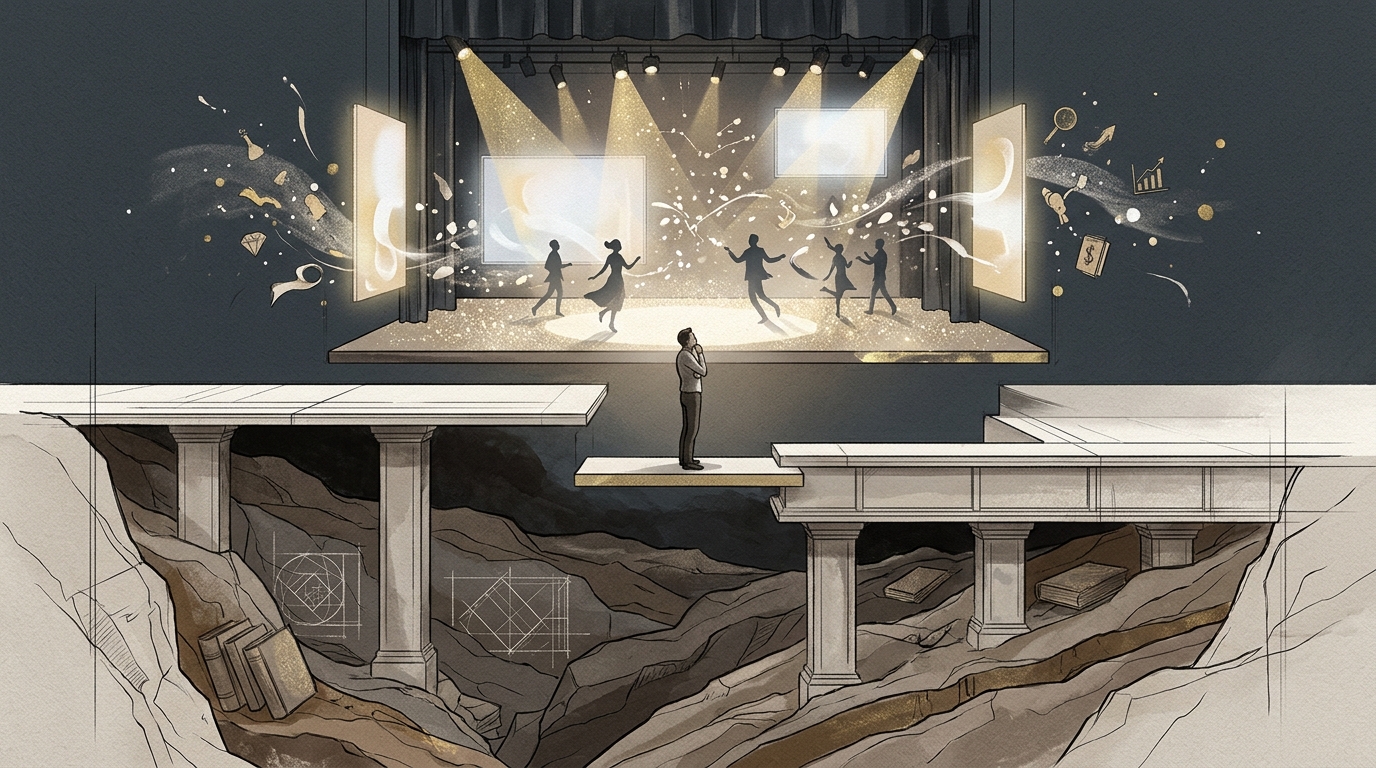
3. The Dopamine Illusion: Evolutionary Circuitry and Novelty Bias
Our instinctive fascination with the new is an evolutionary heirloom. In a landmark 2008 study, neuroscientist Bianca Wittmann and colleagues demonstrated that the human ventral striatum activates far more vigorously when encountering novel options than familiar ones. In ancestral environments, scouting uncharted territory was vital for discovering forage or dodging predators.
Renowned organizational theorist James G. March identified the trade-off between Exploration (seeking new alternatives) and Exploitation (deepening and refining existing capabilities). When this balance tilts excessively toward pure exploration, intellectual bankruptcy inevitably follows.
Algorithmic feeds exploit this evolutionary search loop with ruthless efficiency. Scanning a newly minted phrase or freshly published title floods the striatum with anticipatory dopamine. Yet the brief high of novel exploration is entirely distinct from the disciplined labor of exploitation, which digests foundational principles into actionable wisdom. Those trapped in relentless exploration drown in shallow updates without ever accumulating intellectual capital.
4. The Mathematics of Time: The Lindy Effect and Signal-to-Noise Ratio
Perishable entities like biological organisms and mechanical gears wear down over time, with their remaining life expectancy shrinking each day. Non-perishable assets such as ideas, mathematical models, and foundational literature obey the inverted probability of the Lindy Effect, formalized by Nassim Nicholas Taleb and physicist Iddo Eliazar. If an idea has remained in circulation for a century, its expected future survival is another century. The book published yesterday is most likely to perish tomorrow.
Historically, printing and distribution costs acted as natural filters against intellectual noise. In a digital world where replication costs zero, the volume of noise expands exponentially while the absolute supply of high-value signal remains constant.
In his book Same as Ever, author Morgan Housel argues that instead of guessing what will change in ten years, we should bet on what will never change. Chasing the newest micro-trends is like pouring water into a sieve. By contrast, universal principles regarding human incentives, feedback loops, and probabilistic thinking compound in value across a lifetime.
Loading diagram.
View diagram source
flowchart TD
  subgraph Raw["Raw Inflow (Zero Marginal Cost)"]
    A["Ephemeral Slang & Social Media Memes"]
    B["Tool Syntaxes & Fleeting Updates"]
    C["Multi-Generational Classics & Invariant Laws"]
  end

  A --> D{"Lindy Time Filter"}
  B --> D
  C --> D

  D -->|Validation Failed: Half-life in Days| E["High-Frequency Noise (Filter Out via Via Negativa)"]
  D -->|Applied Utility: Half-life in Months| F["Instrumental Knowledge (Just-In-Time Indexing)"]
  D -->|Validation Passed: Half-life in Centuries| G["Structural Foundations (Compounding Capital)"]

  G ==> H["Autonomous Decision Framework"]
  E -.->|Protection of Attention| H
5. Practical Input Protocol: Three-Tier Filtering and Via Negativa
Treating the Lindy Effect as an epistemic rule does not mean idolizing antiquity for its own sake. It means adopting Via Negativa, the discipline of improvement through subtraction. To preserve cognitive clarity, we must categorize our information diet into three distinct tiers.
Information Tier | Nature & Subject Matter | Expected Half-life | Strategic Action |
|---|---|---|---|
High-Frequency Noise | Generational debates, viral controversies, fleeting slang | Days to weeks | Complete removal (Via Negativa): Zero cognitive budget allocated |
Instrumental Knowledge | Framework syntax, software patches, technical regulatory updates | Months to years | Just-In-Time retrieval: Index for lookup rather than memorizing |
Structural Invariants | Lindy-tested classics, human psychology, systems dynamics, economics | Decades to centuries | Repetitive compounding (Exploitation): Deeply internalized into mental models |
The operational rules are straightforward. First, decline to read books published within the past twelve months until time has done its work. Second, refuse to treat social media generational anxieties as intellectual priorities. Third, bypass the endless cycle of tool updates in favor of mastering the underlying architectural foundations.

6. Whose Approval Do You Seek? Reclaiming Intellectual Autonomy
Watching experienced professionals anxiously seek the approval of youth culture is disheartening. It is not curiosity; it is the abdication of one’s own internal scorecard to an external market of vanity.
Lecturing juniors merely because of seniority is clumsy arrogance, but cravenly worshipping youth for the sake of feeling relevant is equally ignominious. Twenty years of repeating identical mistakes is merely obstinacy, but twenty years of disciplined, reflective practice yields a depth of judgment that no two-year trend spotter can match.
The purpose of study is not to display a trendy veneer for onlookers. It is to construct an unshakeable perspective using principles that have survived the harshest scrutiny of centuries. Do not be embarrassed by your unfamiliarity with ephemeral fads. What is truly tragic is spending a lifetime seeking the approval of others without ever cultivating a single enduring conviction.
Further Questions
All Essays
How mathematicians solved the 43 quintillion states of Rubik’s cube in 20 moves by shifting perspective. Exploring chess invariants, the Einstellung trap, and four distinct exits for navigating complex real-world problems.
Why does linking bonuses to metrics erode craft and collaboration? Exploring Goodhart's Law, the Holmstrom-Milgrom multitask model, and Edward Lazear's Safelite evidence to map when performance pay succeeds versus when it destroys institutions.