Jogyeon: Navigating a Substantialless World

1. The Simulation Engine in the Skull and Essentialism
We live under the quiet conviction that most things are immutable: our character, the inherent traits of others, the finality of success or failure, and even the ultimate meaning of our lives. When betrayed, we conclude the other was intrinsically malicious. When a project collapses, we chastise ourselves as fundamentally incompetent. We agonize over present anxieties as if they will persist forever, while desperately clutching at fleeting happiness.
Beneath all our suffering and restlessness lies an unexamined premise: that things and human beings possess an enduring, fixed essence that can be captured and controlled. Yet the universe never ceases to change. Everything we deem essential assembles and disperses in response to shifting conditions.
Fourteen centuries ago, the Heart Sutra posed a radical challenge to East Asian intellectual history. Does anything we perceive as real exist independently on its own?
Underlying Mechanism: The self and fixed essences are not objective entities in the world, but compressed predictive models fabricated by the brain and language to cope with the overwhelming complexity of dependent arising (Pratītyasamutpāda). "Jogyeon (照見)" is the meta-cognitive awakening that observes this compressed model without mistaking it for reality. The Heart Sutra’s doctrine of Aprāpti (non-attainment) shatters the hubris of assetizing knowledge and enlightenment. Emptiness (Śūnyatā) is not nihilism; it is the prerequisite for acting with boundless care and responsibility without demanding permanent possession.
2. From Closed Objects to Open Networks: Dependent Arising and Emptiness
According to predictive coding theory in cognitive neuroscience, the brain is not a passive recording camera. Trapped within the dark vault of the skull, it acts as a simulation machine continually generating top-down hypotheses to infer sensory input. To minimize computational entropy, the brain takes an economical shortcut: it glues rigid labels such as "naturally like that" or "unchangeable self" across dynamic contexts. Psychologists term this cognitive essentialism.
The famous dictum of the Heart Sutra, "Form is emptiness, emptiness is form (色卽是空 空卽是色)," is far from a lamentation of nothingness. Emptiness (Śūnyatā) does not designate a vacuum. Rather, it signifies that no entity possesses an independent, unconditioned essence (Svabhāva). In Buddhist philosophy, this dynamic web of interdependence is called dependent arising (Pratītyasamutpāda).
Consider a ceramic cup. It is a temporary equilibrium that arises when clay, water, kiln heat, the potter’s hand, and the human intent to drink converge in space and time. If shattered, it can no longer hold water, yet the elemental clay has not vanished. The cup functions effectively to quench thirst, but an isolated, unconditional essence of cupness exists nowhere on its own.
As the philosopher Nāgārjuna articulated in the Mūlamadhyamakakārikā, "That which is dependent arising is what we call emptiness." If an entity possessed an immutable essence impervious to outside conditions, it could never respond to feedback, learn, or transform. Paradoxically, because all things are empty of intrinsic nature, the door remains open for new causes, adaptation, and creative renewal.
3. The Five Aggregates: Debugging the Five System Subroutines of the Self
The opening phrase of the Heart Sutra, "Jogyeon O-on Gae-gong (照見五蘊皆空: Clearly perceiving that all five aggregates are empty)," is the conceptual origin of the journal JOGYEON. It proclaims that the Bodhisattva of Compassion, practicing profound wisdom, clearly illuminated that the five constituents of human experience are devoid of independent selfhood.
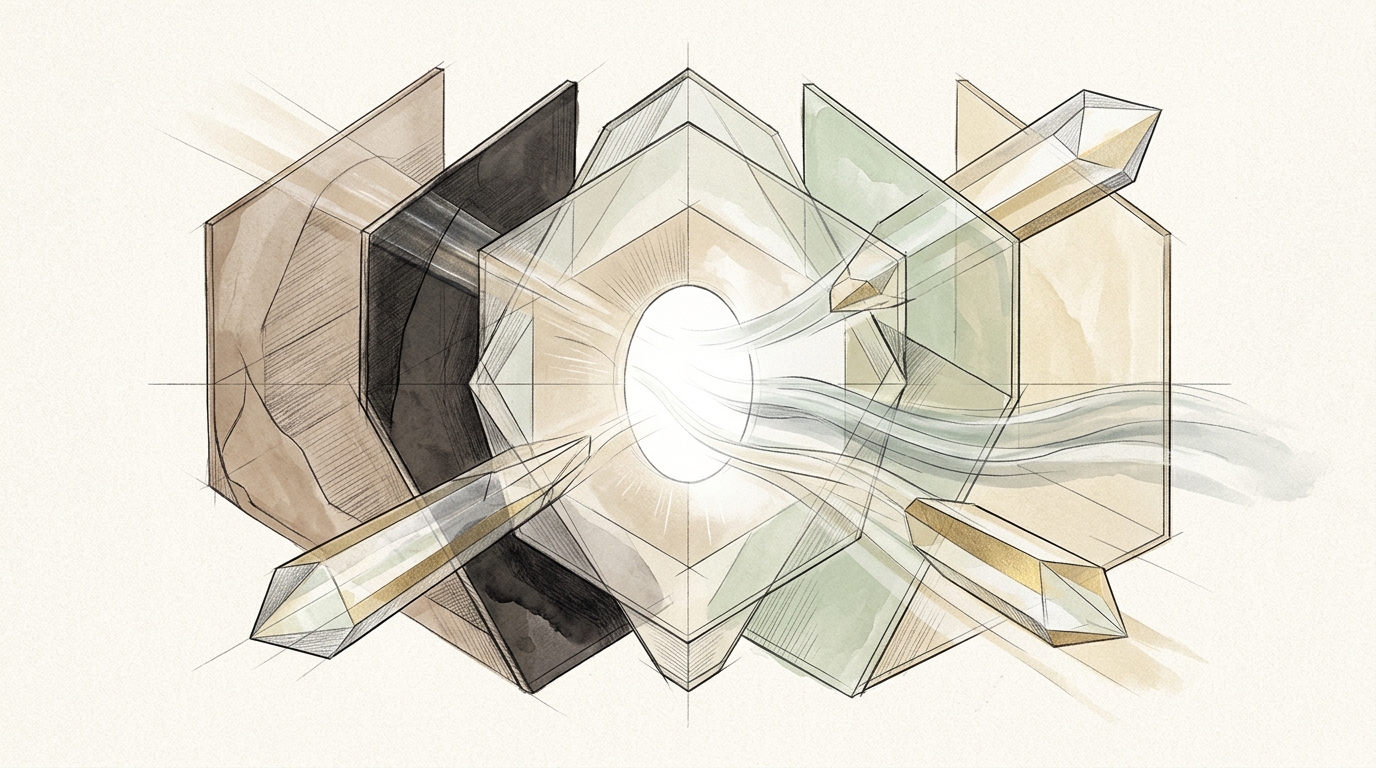
No singular soul or inner homunculus presides over decisions within the human brain. Contemporary cognitive science and the Heart Sutra converge on the realization that the self is an emergent runtime process composed of five interacting subroutines.
The Five Aggregates | System & Cognitive Counterpart | Reification Trap (Attachment) | Insight of Jogyeon (Clarity) |
|---|---|---|---|
Form (色, Rūpa) | Physical body and raw sensory input | My body is my permanent possession | A transient configuration continually exchanging elements with the environment |
Sensation (受, Vedanā) | Immediate valenced status signals (pleasure/pain) | This feeling defines who I am | Transient electrochemical feedback triggered by environmental stimuli |
Perception (想, Saññā) | Pattern recognition and concept labeling | My conceptual categories are eternal truths | Convenient boundary markers established for communication (nominal designations) |
Mental Formations (行, Saṅkhāra) | Volitional impulses and habit loops | I am in total control of my thoughts | Conditioned behavioral tendencies shaped by cumulative past feedback |
Consciousness (識, Viññāṇa) | Integrated runtime process (awareness) | An immortal observer soul resides within | A stream of awareness that arises when the lower four routines interact |
The brain attaches a compressed tag labeled "Self" to this shifting symphony, deploying defensive armor to preserve its coherence. Jogyeon (照見) is the meta-cognitive decentering that steps back to observe these five streams without mistaking the simplified map for the living territory.
Loading diagram.
View diagram source
flowchart TD
  subgraph Inflow["Inflow of External Conditions"]
    A["Stimulus & Environmental Events"]
  end

  A --> B["Sensory Reception (Form)"]
  B --> C["Valenced Signal (Sensation)"]
  C --> D["Conceptual Tagging (Perception)"]
  D --> E["Habitual Impulse & Action (Formations)"]
  E --> F["Integrated Awareness (Consciousness)"]

  F -.->|Reification of Self| G{"Attachment to an Immutable Self"}
  G -->|Confronting Inevitable Change| H["Severe Predictive Error & Suffering (Dukkha)"]

  F ==>|Jogyeon: Illuminating Emptiness| I{"Awareness of Dependent Arising"}
  I -->|Embracing Groundlessness| J["Fluid Adaptation & Inner Freedom (No Obstacles)"]
4. The Thunderbolt of Aprāpti: Shattering the Assetization of Enlightenment
Midway through the text, the Heart Sutra delivers a startling deconstruction of core Buddhist dogma: "There is no suffering, no origin of suffering, no cessation of suffering, and no path (無苦集滅道). There is no wisdom, and no attainment (無智亦無得)." Why does the sutra repudiate the Four Noble Truths? Because the grasping human ego inevitably tries to convert enlightenment or equanimity into yet another trophy to possess.
Modern society frames life around accumulation. We amass wealth, monopolize prestige, and even treat reading and contemplation as the acquisition of intellectual capital. We assume that mastering elaborate theories grants us total control over future uncertainty.
Yet knowledge is merely a finger pointing toward reality, not reality itself. The moment we cling to doctrines, we cease to observe the world with humility and instead use dogmatic lenses to judge and condemn others. The Heart Sutra’s declaration of Aprāpti (無所得: non-attainment) is not nihilistic cynicism. It is a purifier that dismantles spiritual capitalism and intellectual vanity.
5. The Two Truths: Transcending the Trap of Nihilism
Misunderstanding emptiness as blank nothingness leads to the poison of nihilism: the cynical stance that since everything is illusory, ethics and commitments are meaningless. Classical Buddhism compared this to catching a venomous snake by the tail: it turns and strikes.
Nāgārjuna’s Madhyamaka philosophy carefully articulates the doctrine of the Two Truths: Conventional Truth (Saṃvṛti-satya) and Ultimate Truth (Paramārtha-satya).
Dimension | Core Perspective | Practical Posture | Potential Trap |
|---|---|---|---|
Ultimate Truth (Paramārtha) | Radical emptiness, lack of fixed essence, Aprāpti | Inner stillness and freedom from outcome attachment | Nihilistic cynicism, moral abdication |
Conventional Truth (Saṃvṛti) | Cause and effect, contracts, ethical duty | Conscientious action, compassionate care for suffering | Blind possessiveness, panic over lack of control |
The Middle Way (Synthesis) | Inhabiting conventional reality through the lens of ultimate emptiness | Care without possession, courageous engagement | Fluid progress free from rigid extremes |
To dismiss the grief of losing a loved one or the pain of systemic injustice as mere illusion is not wisdom; it is callous evasion. The Heart Sutra does not invite us to abandon the arena of daily life. It inspires us to play our hand on the table with total devotion, knowing full well that every card is temporary.

6. Crossing to the Other Shore: Responsibility without Possession
The scripture concludes with its legendary mantra: "Gate gate pāragate pārasaṃgate bodhi svāhā" (Gone, gone, gone beyond, gone completely beyond; hail the awakening!). Where is this "other shore" (pāramitā)? If we picture an otherworldly heaven outside reality, we fall once more into dualism.
To cross over means to transform our orientation toward reality: ceasing the desperate bid to micromanage uncertainty, refusing to imprison ourselves within titles or past failures, and caring tenderly for the fleeting beings and tasks in our stewardship without demanding permanent ownership.
Those who perceive emptiness experience no mental hindrances (心無罣礙) because they have relinquished the claim to control the uncontrollable. The freedom offered by the Heart Sutra is not the cold apathy that nothing matters, but the quiet courage to live, act, and love wholeheartedly without the illusion of possession.
Appendix: The Complete Heart Sutra (Text, Transliteration, Translation)
The canonical 260-character Chinese translation by Xuanzang (玄奘), alongside romanized readings and English translation, preserving the contemplative rhythm that gave birth to the journal JOGYEON (照見).
Section | Chinese Text (漢文) | Romanized Reading | English Translation |
|---|---|---|---|
Title | 摩訶般若波羅蜜多心經 | Móhē Bōrě Bōluómìduō Xīnjīng | The Heart of the Perfection of Transcendent Wisdom Sutra. |
1. Illuminating Emptiness | 觀自在菩薩 行深般若波羅蜜多時 照見五蘊皆空 度一切苦厄 | Guānzìzài Púsà, xíng shēn Bōrě Bōluómìduō shí, zhàojiàn wǔyùn jiē kōng, dù yíqiè kǔ’è. | When Avalokiteshvara Bodhisattva practiced deep Prajna Paramita, he clearly perceived that all five aggregates are empty, transcending all suffering and adversity. |
2. Form and Emptiness | 舍利子 色不異空 空不異色 色卽是空 空卽是色 受想行識 亦復如是 | Shèlìzǐ! Sè bù yì kōng, kōng bù yì sè; sè jí shì kōng, kōng jí shì sè. Shòu, xiǎng, xíng, shí, yì fù rú shì. | Shariputra! Form is not different from emptiness; emptiness is not different from form. Form is emptiness; emptiness is form. Sensation, perception, volitional formations, and consciousness are also like this. |
3. Characteristics of All Dharmas | 舍利子 是諸法空相 不生不滅 不垢不淨 不增不減 | Shèlìzǐ! Shì zhū fǎ kōng xiàng: bù shēng, bù miè; bù gòu, bù jìng; bù zēng, bù jiǎn. | Shariputra! All dharmas are characterized by emptiness: they are neither produced nor destroyed, neither defiled nor pure, neither increasing nor decreasing. |
4. The Ground of Emptiness | 是故 空中無色 無受想行識 無眼耳鼻舌身意 無色聲香味觸法 | Shìgù kōng zhōng wú sè, wú shòu, xiǎng, xíng, shí; wú yǎn, ěr, bí, shé, shēn, yì; wú sè, shēng, xiāng, wèi, chù, fǎ. | Therefore, in emptiness there is no form, no sensation, perception, volition, or consciousness; no eye, ear, nose, tongue, body, or mind; no sights, sounds, smells, tastes, touches, or objects of mind. |
5. Dissolving Chains of Becoming | 無眼界 乃至 無意識界 無無明 亦無無明盡 乃至 無老死 亦無老死盡 | Wú yǎnjiè, nǎizhì wú yìshíjiè; wú wúmíng, yì wú wúmíng jìn; nǎizhì wú lǎosǐ, yì wú lǎosǐ jìn. | No realm of sight, up to no realm of consciousness; no ignorance and no end of ignorance, up to no aging and death and no end of aging and death. |
6. Declaration of Aprāpti | 無苦集滅道 無智亦無得 以無所得故 | Wú kǔ, jí, miè, dào; wú zhì, yì wú dé. Yǐ wúsuǒdé gù. | There is no suffering, no cause of suffering, no cessation, and no path; no wisdom and no attainment, because there is nothing to attain. |
7. Freedom from Hindrance | 菩提薩埵 依般若波羅蜜多故 心無罣礙 無罣礙故 無有恐怖 遠離顚倒夢想 究竟涅槃 | Pútísàduǒ, yī Bōrě Bōluómìduō gù, xīn wú guà’ài; wú guà’ài gù, wú yǒu kǒngbù, yuǎnlí diāndǎo mèngxiǎng, jiùjìng nièpán. | Bodhisattvas rely on Prajna Paramita, and so their minds have no hindrances; with no hindrances, they have no fear. Free from upside-down delusions, they realize ultimate Nirvana. |
8. Attainment of All Buddhas | 三世諸佛 依般若波羅蜜多故 得阿耨多羅三藐三菩提 | Sānshì zhūfó, yī Bōrě Bōluómìduō gù, dé ānòuduōluó sānmiǎosānpútí. | All Buddhas of the past, present, and future rely on Prajna Paramita and attain Anuttara-samyak-sambodhi (unexcelled, perfect enlightenment). |
9. Praise of Prajna | 故知 般若波羅蜜多 是大神呪 是大明呪 是無上呪 是無等等呪 能除一切苦 眞實不虛 | Gù zhī Bōrě Bōluómìduō shì dà shénzhòu, shì dà míngzhòu, shì wúshàngzhòu, shì wúděngděngzhòu, néng chú yíqiè kǔ, zhēnshí bù xū. | Therefore, know that Prajna Paramita is the great transcendent mantra, the great illuminating mantra, the supreme mantra, the unequaled mantra, which removes all suffering and is true, not false. |
10. The Great Mantra | 故說 般若波羅蜜多呪 卽說呪曰 揭諦揭諦 波羅揭諦 波羅僧揭諦 菩提娑婆訶 | Gù shuō Bōrě Bōluómìduō zhòu, jí shuō zhòu yuē: Gate gate pāragate pārasaṃgate bodhi svāhā. | Therefore proclaimed is the Prajna Paramita mantra, saying: Gate gate pāragate pārasaṃgate bodhi svāhā (Gone, gone, gone beyond, gone completely beyond, hail the awakening!). |
Further Questions
All Essays
The dilemma of resource allocation between refining existing competencies and venturing into the unknown. Examining James G. March’s model of organizational learning, the competency trap, and how the pursuit of efficiency stifles long-term adaptation.
Why does linking bonuses to metrics erode craft and collaboration? Exploring Goodhart's Law, the Holmstrom-Milgrom multitask model, and Edward Lazear's Safelite evidence to map when performance pay succeeds versus when it destroys institutions.